
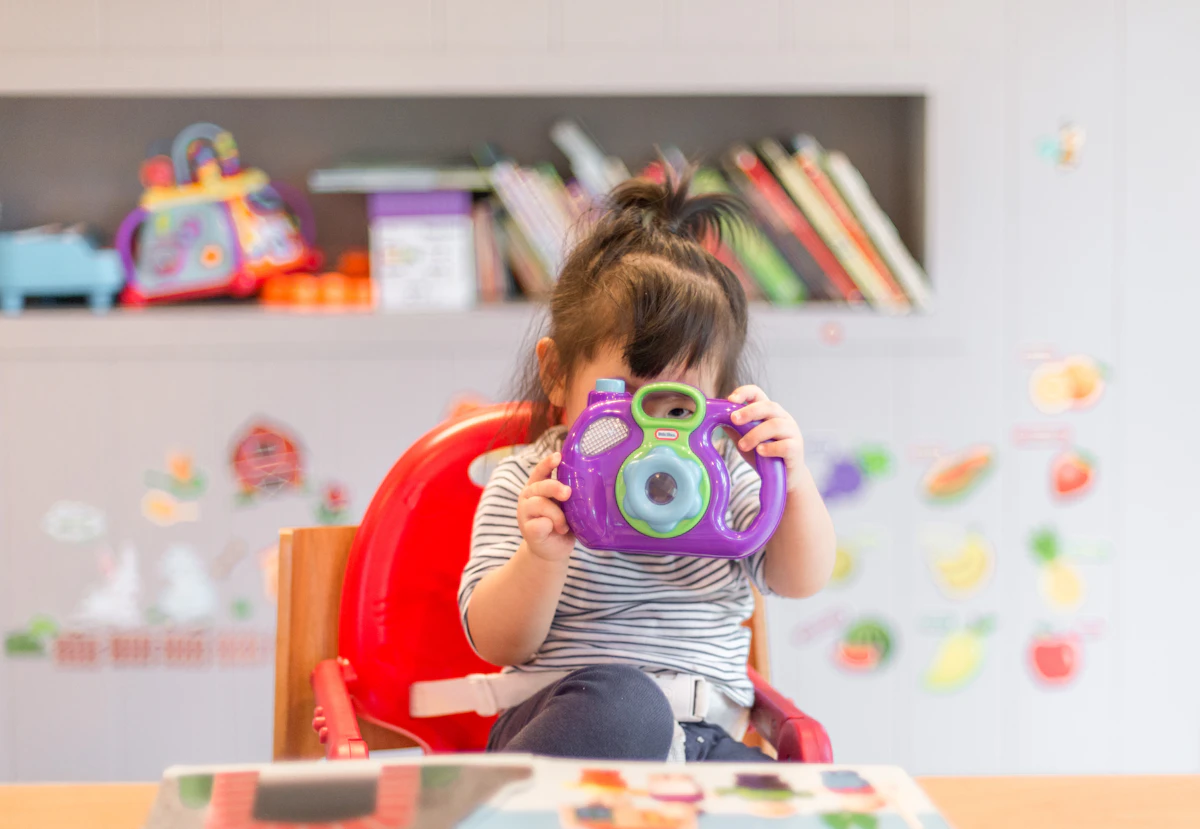
The Invisible Gym
Have you ever watched a four-year-old try to build a "bridge" between two chairs using only a silk scarf and a heavy book? You see the frustration. You see the book slide off for the tenth time. You see the scarf slip.
To an untrained eye, this looks like "just play." It looks like a mess. But if you could put that child under an MRI at that exact moment, you would see a firestorm of neurological activity. That child isn't just playing; they are in the middle of a high-intensity workout in the Invisible Gym of the Brain.
The Muscle of "The Struggle"
The American Academy of Pediatrics (AAP) made a bold statement recently: Play is not a luxury. It is a biological necessity.
When a child "struggles" to make that bridge work, their brain is releasing a protein called BDNF (Brain-Derived Neurotrophic Factor). Think of it as "Miracle-Gro" for the brain. It helps neurons branch out and connect.
But here is where most parents—with the best intentions in the world—accidentally become "Neural Thieves."
We see the book fall. We see the lip quiver. And we rush in. “Here, sweetie, let Mommy do it. Use this tape. Put the book here.”
In that moment, we have just walked over to their mental gym and lifted the weights for them.
Question 1 of 3
How long can your child play completely independently without a screen?
The "Loose Parts" Revolution
Every time we "fix" a play-based problem for a child, we rob them of a neural connection. We are essentially telling their brain: "You don't need to find a solution; the adult is the solution." Over time, this creates a child who is "brilliant" at following directions but "helpless" when the directions disappear.
In a world of "Smart Toys" that beep, boop, and tell stories, we are actually dumbing down the play experience. A toy that has only one way to be played with (push the button, hear the song) is a "closed" toy. It’s a "Single-Tasker."
Compare that to a cardboard box. A box can be a rocket, a cave, a stove, or a hat. This is what researchers call "Loose Parts" theory. The more a toy does, the less the child’s brain has to do. The less a toy does, the more the child’s brain has to work.
Intelligence is not about how many "educational" apps your child can navigate; it’s about how many uses they can find for a stick.
Designing the Laboratory
If we want our children to be the innovators of the future—the ones who will steer the AI, not be steered by it—we have to treat our homes like laboratories, not showrooms.
This requires a fundamental shift in how we organize our lives. You need an environment that says "Yes" to exploration before it says "No" to the mess. You can start creating this "Yes Space" with the Home OS System. It’s the blueprint for a home that facilitates deep, uninterrupted play.
But space is only half the battle. The other half is time. Deep play—the kind that builds genius—requires at least 45 to 90 minutes of "Uninterrupted Flow." If we are constantly dragging them from a drawing to a bath to a meal to a class, we are shattering their concentration.
To protect their "Flow States," use the Daily Flow Builder. Give them the gift of time. Give them the gift of struggle. Let them build their bridge.