
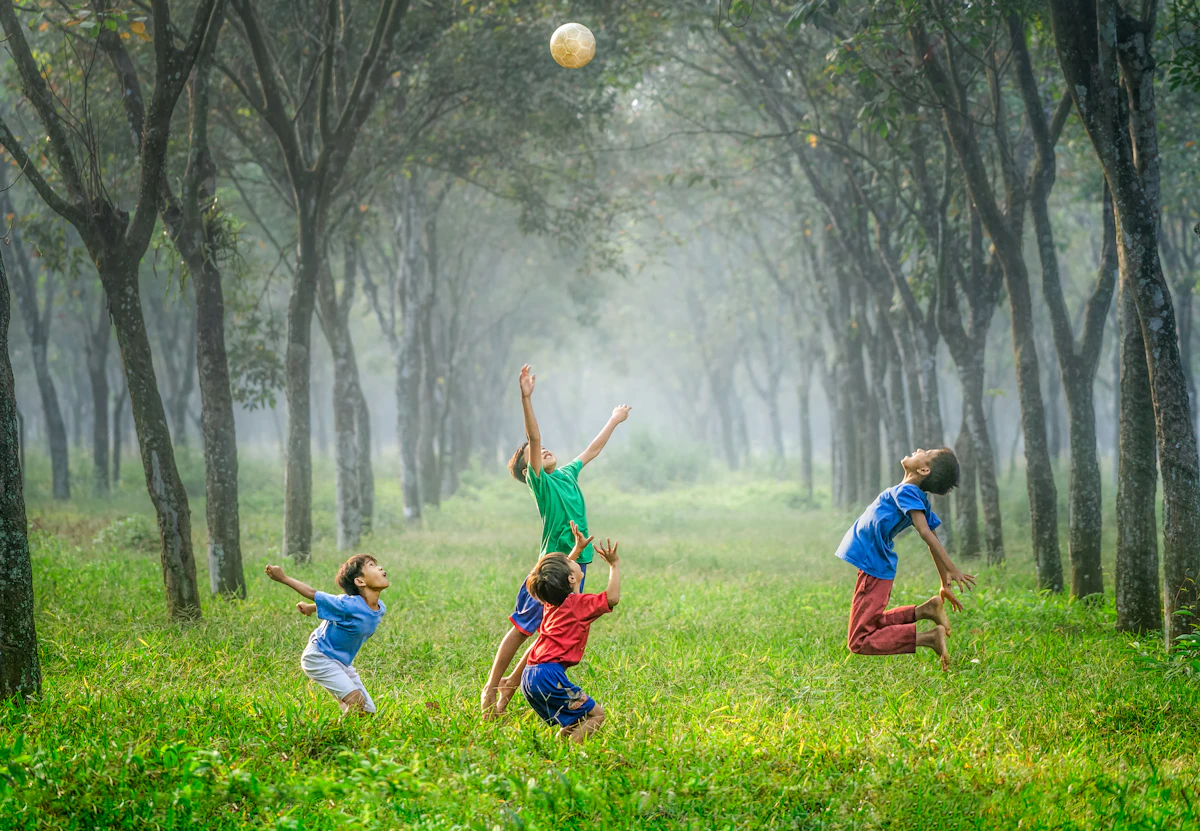
The "Hothouse" vs. The "Wild Garden"
Whenever a parent mentions they are considering alternative education or homeschooling, the same question inevitably pops up, usually accompanied by a concerned tilt of the head:
"But... what about socialization?"
It’s the ultimate "checkmate" question. We have been conditioned to believe that a school building is the only place on earth where a child can learn to be a functioning member of society. But if we look closely at how schools "socialize" children, the logic starts to crumble.
Schooling is like a "Hothouse." It is an artificial, controlled environment where plants (children) are grown in rows, separated by "manufacture date" (age), and given exactly the same nutrients at the same time.
The "Real World," however, is a Wild Garden.
The Age-Segregation Trap
In what other part of human life are you segregated solely by your age? Not in your job. Not in your family. Not in your community.
When you put thirty 6-year-olds in a room together, you don't get "socialization." You get a "Lord of the Flies" lite. They all have the same level of emotional immaturity. They all have the same limited vocabulary. They often fall into patterns of bullying, peer pressure, and "performance" just to survive the social hierarchy.
Real socialization is mixed-age.
Question 1 of 3
How long can your child play completely independently without a screen?
Research shows that when a child interacts with people older and younger than them, something magical happens. The older child learns to be a mentor, a protector, and a teacher (building empathy). The younger child learns to observe, listen, and "level up" their behavior to match the "big kids."
The Skill of the Future: Adaptability
In the AI era, the most important social skill isn't "standing in a line" or "raising your hand." It’s Adaptability.
It’s being able to talk to a 70-year-old neighbor about their garden, negotiate a game with a 4-year-old, and ask an expert for help. Schools often "socialize" the curiosity out of children by making communication something that only happens during "Recess."
True social intelligence is built in the "In-Between" moments:
- Navigating a crowded market with you.
- Interacting with the plumber who came to fix the sink.
- Ordering their own food at a restaurant.
- Resolving a conflict with a sibling over a shared toy.
These are "unscripted" interactions. They require real-time empathy and problem-solving.
Turning Your Home into a Social Hub
If you want your child to be socially "brave," you have to stop thinking of socialization as something that happens "out there" and start seeing it as something you facilitate from "in here."
Your home should be a bridge to the world, not a bunker. By using the Home OS System, you can organize your space to be "guest-friendly" and community-centered. It allows you to have a "command center" for your family’s social life.
But community takes time. You can’t have deep social connections if your child is exhausted after an 8-hour school day and 2 hours of homework. You need a Daily Flow Builder that leaves room for "The Village." It allows you to schedule park dates, community service, or mixed-age workshops that provide high-quality socialization rather than just high-quantity proximity.
Don't worry about the "Socialization Myth." A child who knows how to navigate the "Wild Garden" of the real world will always be more successful than one who was raised in a hothouse.